A member told us recently, with some pride, that he had just finished a week of ten-hour nights. He also looked terrible. His HRV had drifted low. His fasting glucose had crept up. His afternoons were flat. What he had accumulated was time in bed — and almost none of the sleep that does the work.
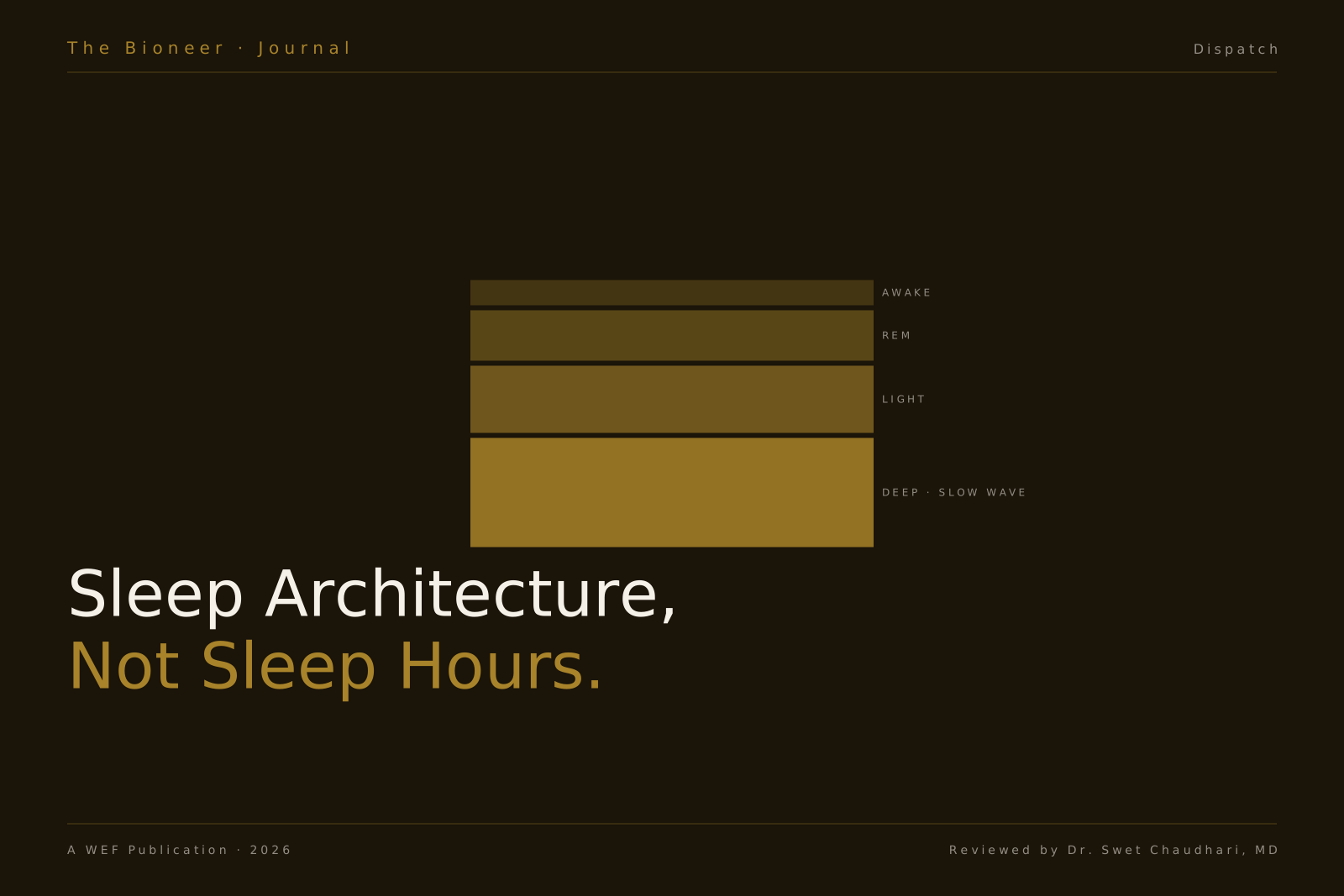
The public conversation about sleep is obsessed with duration and almost silent about architecture. Duration is the easy metric: it fits on a lockscreen, it totals cleanly across a week, it is what most wearables report as their headline. Architecture is the real one — the distribution across N1, N2, slow-wave (N3), and REM stages that determines whether the hours in bed did anything besides pass the time.
What each stage is actually for
A healthy adult cycles through four to six sleep architectures across a night. Early cycles are dominated by slow-wave sleep — the deep, restorative stage in which growth hormone pulses, intracellular repair proceeds, and glymphatic clearance of metabolic byproducts from the central nervous system is most active. Later cycles are dominated by REM — the stage in which memory consolidation, emotional processing, and a disproportionate share of neuroplasticity occur.
Both stages matter. They do different work. The body prioritizes slow-wave first, which is why a person who gets only six hours of sleep still gets most of their slow-wave requirement, but loses a disproportionate share of their REM. Cut the night short and you cut the stage that happens last, which happens to be the one that governs how the brain feels in the morning.
Fragmentation — waking even briefly — disrupts the architecture disproportionately. A single arousal in the third cycle can collapse what would have been 25 minutes of REM into 8. The wearable will still report the minutes; the brain will not feel them.
What the data says
The cleanest large-cohort work linking sleep duration to mortality is from Cappuccio and colleagues, who in a 2010 meta-analysis of more than 1.3 million subjects found a U-shaped relationship: both short sleep (less than six hours) and long sleep (more than nine hours) were associated with increased mortality. The long-sleep finding is partly confounded — the people sleeping ten hours are often doing so because they are unwell — but the short-sleep finding is robust across studies and mechanisms.
Below that cohort-level summary sits the architecture story. Ohayon’s normative data, updated most recently in 2017, give the reference ranges for slow-wave and REM percentages across adult age groups. A typical healthy 40-year-old should see 13 to 23 percent of total sleep in slow-wave and 20 to 25 percent in REM. Values meaningfully below those bands, sustained across weeks, are a signal worth taking seriously — regardless of how much total time was logged.
On continuous-monitoring data from Oura, WHOOP, and similar consumer wearables, de Zambotti and colleagues at SRI have repeatedly shown decent accuracy for total sleep time and sleep-wake detection, with worse accuracy for stage-by-stage classification. The numbers on the app are a useful compass, not a sleep lab. A trend is meaningful; a single night’s REM percentage is not.
What fragments the architecture
The list is unromantic and under-appreciated:
- Alcohol within three hours of bed. Alcohol truncates REM more reliably than almost any other exposure, and the metabolism of ethanol produces a second-half-of-night sympathetic surge that wakes the body in ways it does not remember. Members who track this see the effect clearly.
- Late meals. Eating within two to three hours of sleep onset raises core temperature, delays melatonin, and compresses the early slow-wave block.
- Ambient temperature. The bedroom needs to be cooler than the daytime space — 65 to 68°F is a reasonable target. Temperature drift is one of the most common and most fixable disruptors.
- Evening blue-light exposure. The effect size is smaller than the popular discussion suggests, but real, and compounds with late eating and alcohol.
- Late caffeine. The half-life is five to six hours. The 3 PM coffee is still 40 percent active at 9 PM. For sensitive responders, this is meaningful.
- Shift-work and travel. Nothing we can prescribe un-does biology. The protocol becomes damage control: morning light, strategic caffeine, structured meal timing, no alcohol.
What strengthens it
In the recovery suite and across the weekly schedule, a handful of inputs consistently show up as architecture-positive:
- Zone 2 cardio earlier in the day, three or more sessions per week. The aerobic base work we cover in a separate piece is one of the cleanest predictors of slow-wave percentage.
- Resistance training timed at least four hours before bed. Evening lifts raise cortisol and core temperature; members sleeping poorly after 6 PM training sessions usually see the problem resolve with a schedule shift.
- Passive heat exposure 90 to 180 minutes before bed. The infrared sauna protocol — 15 to 20 minutes, then a slow cool-down — produces a core-temperature rebound that facilitates sleep onset and deepens the first slow-wave block. This is the clearest single input for members who struggle at the beginning of the night.
- Magnesium glycinate, 200 to 400 mg in the hour before bed, for members whose baseline intake is insufficient. The glycinate form is the one we prefer for GI tolerance and GABA-ergic signaling.
- Dark, cool, quiet. The room is infrastructure. Fixing the room often does more than the supplement stack.
The clinical question to ask each morning
Not “how long did I sleep.” Three questions, in order:
- Did I fall asleep quickly? (Sleep latency under 20 minutes is healthy; under 5 is sometimes a sign of meaningful sleep debt.)
- Did I wake up during the night? (Brief awakenings are normal; more than three with inability to fall back is a pattern worth investigating.)
- Did I wake feeling restored? (The subjective felt sense is the most underrated diagnostic in sleep medicine. It tracks the architecture better than the wearable does.)
Three yeses, across a week, is what the clinical target looks like. Total hours, within a reasonable band, are almost beside the point.
You are the kind of person who has already optimized the obvious. The next increment is not earlier bedtime. It is protecting the hours you already have from the inputs that fracture them — and recognizing that the seven structured hours your grandmother got in a quiet farmhouse are the asset your calendar is trying to imitate.
— Published in The Bioneer, Journal.